
The Death of Context
How Information lost its surroundings

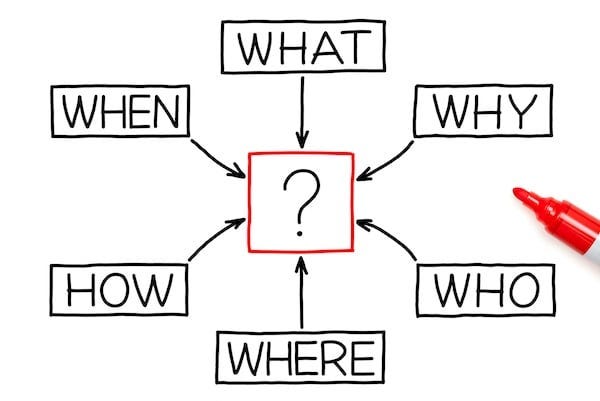
We called them “the five Ws”—what, when, where, who, why. “How” frequently tagged along at the end. These words helped us interpret the world. They anchored things in time and place; they defined the event and named the parties responsible; they explained motivations and the manner in which things took place.
The five Ws helped us build meaning. We could understand an event’s importance, or lack thereof, because we had placed it in its proper context.
Not every incident could be placed into its proper 5W+H category. These incidents became mysteries. Like ancient rituals, they took us to the edge of meaning. They haunted us because they pointed toward a thing we did not and could not understand. When we finally found that answer—when we discovered whodunit, when we established the motive, when we learned how it was done—we were enlightened. We had looked into the void and returned with an answer.
You can only have a mystery if somebody wants to solve it.
Today the void is filled with viral clips, unsourced quotes, and declarations of belief or enmity. An adorable kitten purrs. An angry person proclaims their love for a cause, or their hatred of those who oppose it. Two people fight for unknown reasons. There is no beginning, middle, or end. They are fragments of an event, a life, a thought. They seek neither to explain, persuade, or debate.
These viewers are not concerned with meaning, context, or explanation. The fragment delivers its conclusion in the form of an emotional response. The question has shifted from “what does this mean?” to “how does this feel?”
Context is replaced by something simpler and faster. Labels, captions, and titles tell the viewer how to respond to the clip. Are you supposed to be filled with schadenfreude as an ANGRY KAREN GETS HUMBLED? Do you want to coo with joy because the costumed CUTE PUPPY THINKS HE’S A DUCK? The poster provides you all the guidance you need. You pick and choose your clips based on your desired emotion in the moment.
Once writers were expected to “show, not tell.” You established your character’s traits through behavior, not by explaining “Howard was cowardly” or “Eliza was a chatterbox.” That rule does not apply to clips. The titles assign roles and tell viewers how they should feel about the action.
Feeds prioritize immediacy and attention rewards intensity. Conventional storytelling may begin in media res, but it then works to situate that moment within a broader narrative. Slower moments appear throughout even the most fast-paced work. They give the viewer time to absorb information and to understand what they are seeing.
There are no slow moments in clips, and no effort to provide additional information. They do not tell a creative story—they isolate a moment and amplify it for maximum emotional impact.
Another type of clip features individuals talking about themselves: what they hate, what they love, what identities they claim. These statements are rarely accompanied by explanation or argument. The point is not persuasion, but declaration.
The response reflects that structure. Comments cluster into affirmation or rejection. These exchanges are not debates, but displays. Like the poster, commenters signal their alignment. The clip is not so much a vehicle for communication as a marker of identity.
Stories resolve ambiguity. Clips produce tension that is relieved through an emotional reaction. Some are driven by cuteness; others rely on outrage, fear, or vindication to fuel their virality. Emotions spread faster than resolution. Without context, meaning becomes unstable, contested, and narrative-driven. There is no way to know—and little interest in—what actually happened.
Wrong conclusions often feel right. They seem to make sense, and they fit your preconceptions. But when put into practice, those conclusions can quickly unravel. When we grow accustomed to prioritizing feeling over evidence, we may remain committed to an error long after its flaws become apparent.
Conflict escalates quickly in a feelings-driven environment. Anger demands release, and when people are riled up, they are more likely to lash out. If no clear target presents itself, the impulse remains. Once immediate emotional response becomes habitual, restraint becomes harder to maintain.
Shared emotion can unite people. Emotional outrage often brings them together as a mob. These emotions become a point of coordination. Without context, there is no background for reframing the event and no competing narrative to slow the reaction. It is easy to justify an immediate response to an apparent atrocity—and difficult to undo the damage if that atrocity proves to be misrepresented or misunderstood.
The death of context weakens our ability to interpret what we are seeing. Fragments deliver immediate emotional payoff with no questions. Statements like “this person is evil” or “that group is extremist” arrive already packaged with an emotional charge. Repeated exposure to this pattern lowers resistance. Strong reactions become easier to trigger and harder to question.
Outsourcing our thinking to others is risky. Outsourcing our emotions to someone else is dangerous. When we become accustomed to reacting through someone else’s lens, those responses can begin to feel like our own. Strongmen throughout history have relied on this dynamic. They draw people into narratives that shape not only what they think, but what they feel and who they should hate.
Context enables distance. Critical thinking allows us to step back from an immediate reaction and weigh evidence against the situation. When that habit weakens, the ability to pause and evaluate weakens with it. The result is not a lack of intelligence, but a shift in how judgment is formed—faster, more reactive, and more prone to error.
These outcomes are not inevitable. They are patterns that this environment can amplify, not destinies it must fulfill. These systems can accelerate reaction, but they can also be navigated with care. Recognizing these tendencies is the first step toward resisting them. The challenge is not to reject the medium, but to remain aware of how it shapes perception—and to preserve the habits of thought that allow us to question what we see.
So what can we expect in a context-poor world?
Many assume it will lead to a decline in intelligence, morality, and cultural standards. We saw similar complaints about television. Guy Debord’s vision of a passive population entertained by the Spectacle owed a great deal to TV. But while there was a great deal of bad television produced, we managed to make it through the age of broadcast—and streaming video—with our culture more or less intact.

With the advent of photography, images became far more accessible to the public. You no longer had to travel to the Louvre to glimpse the Mona Lisa; you could see her in a book, a photograph, or a printed reproduction. As access to historical art expanded, contemporary art began to change in response.
For much of its history, Western artists emphasized representation. Portraits and landscapes sought to capture the likeness of a person or the character of a place. By the late 19th century, photography could reproduce images faster—and often more precisely—than painters, engravers, or lithographers.
The function of art began to shift. Expressionism sought to capture emotions; Impression focused on the play of light and perception; Surrealism evoked the language of dreams and hallucinations; Dada caught the zeitgeist of a world reeling from the Great War.
But many audiences preferred photos and lithographs of historic paintings to contemporary art. As Walter Benjamin complained in his 1936 essay, “The Work of Art in the Age of Mechanical Reproduction,” the conventional was uncritically enjoyed, while the truly new was criticized with aversion.
Taken from their original time and place, these works entered a new context. They became not just images, but signifiers of taste, education, and cultural inheritance. The paintings of Leonardo, Raphael, and Michelangelo were no longer simply works of art; they were emblems of a distant past, objects of reverence as much as understanding.
New forms of media do not destroy meaning. They reshape how it was created. Television didn’t kill thought, but it changed its form. Photography didn’t kill art, but it changed its function. Clips will not kill meaning, but they will change how it is shaped. The form changes, and with it, the function.
This shift is more fundamental because it affects context itself. TV, film, and journalism preserved narrative and framing. Clips rely on fragments where context is optional. We are not just changing how we tell stories—we’re changing how we situate events. Context is no longer assumed. It must be reconstructed if it is desired at all.
We will learn to navigate this new environment as we have navigated other technological changes. A new literacy may emerge that is more skeptical and more skilled at pattern recognition. But what we gain in speed, we may lose in depth.
The new environment will reshape older forms, but it will not replace them. We will still see long-form content and an emphasis on the five Ws. Just as photographic reproduction changed the context of historical art, we may see deep, contextual work as a sign of cultural sophistication and historical films as emblems of a slower, more reflective age. We will not lose meaning, but we are changing how—and whether—we look for it.