The Shadow Over The West
Lovecraft, Tolkien, Guenon, and the Power of Myth
The population is a hopeless tangle and enigma; Syrian, Spanish, Italian, and negro elements impinging upon one another, and fragments of Scandinavian and American belts lying not far distant. It is a babel of sound and filth, and sends out strange cries to answer the lapping of oily waves at its grimy piers and the monstrous organ litanies of the harbour whistles. Here long ago a brighter picture dwelt, with clear-eyed mariners on the lower streets and homes of taste and substance where the larger houses line the hill. One can trace the relics of this former happiness in the trim shapes of the buildings, the occasional graceful churches, and the evidences of original art and background in bits of detail here and there—a worn flight of steps, a battered doorway, a wormy pair of decorative columns or pilasters, or a fragment of once green space with bent and rusted iron railing. The houses are generally in solid blocks, and now and then a many-windowed cupola arises to tell of days when the households of captains and ship-owners watched the sea.
From this tangle of material and spiritual putrescence the blasphemies of an hundred dialects assail the sky. Hordes of prowlers reel shouting and singing along the lanes and thoroughfares, occasional furtive hands suddenly extinguish lights and pull down curtains, and swarthy, sin-pitted faces disappear from windows when visitors pick their way through. Policemen despair of order or reform, and seek rather to erect barriers protecting the outside world from the contagion.
H.P. Lovecraft, “The Horror at Red Hook,” 1927
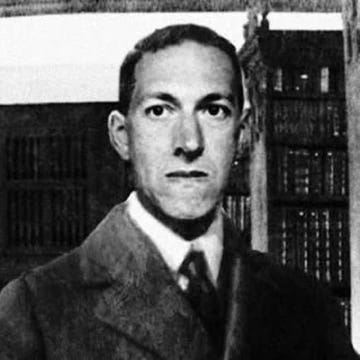
Howard Philips Lovecraft has been no-platformed at the World Fantasy Awards since 2016. He’s a regular target of huffy criticism on sites like Tumblr and Bluesky. (As a consolation prize, edgelords regularly reference Lovecraft’s cat). His virulent racism hasn’t dented his influence. Like JK Rowling, H.P. Lovecraft is too big to cancel. But it has certainly cast his life and work in a harsh and often critical light.
Many have tried to justify Lovecraft’s opinions by pointing out that it was a different time. The 1920s were certainly more tolerant of certain words and ideas. But even by that period’s standards, Lovecraft was uncommonly preoccupied with race. It wasn’t so much that his ideas were distasteful or offensive by the standards of the day. Most were taken as a given. But Howard regularly shared his thoughts on the topic with his readers and his friends… and shared them, and shared them, and shared them.
Both of Lovecraft’s parents died in mental hospitals. He spent his life fearing that he had inherited their madness. This inspired tales of misbegotten miscegenation like “Arthur Jermyn,” “The Lurking Fear,” and “The Shadow Over Innsmouth.” This fueled much of his racism and fear of tainted blood. But while some critics (notably Edmund Wilson) dismiss his work as the scribblings of a sick mind, one can hardly expect to understand Lovecraft as the product of toilet training and Oedipus complexes.
We can argue about whether mystical experiences involve contact with the Divine; a hard atheist like HPL would certainly dismiss such an idea out of hand. But certain people, for whatever reason you might prefer, experience synesthesia and visions of Something Else. Lovecraft was one of those people. These visions cloak themselves in the mystic’s religious preconceptions. Lovecraft viewed the world through an atheistic lens, so he had nightmares of the vast, cold Void and the Things lurking therein.
Like William Blake, Lovecraft put his visions on paper. He provided a materialist world with fire-and-brimstone sermons that lay bare the demons beyond our vision. He showed us the existential terror of life as specks residing on a small planet around a middling star in a universe vaster than we can imagine and cosmic beings that greet us with indifference or hunger. His were not the cheery futures of space opera but the dark tragedy at the heart of our existence.
Whether we condemn or appreciate Lovecraft’s literary output, we view it through our own lenses. The horror we see resonates with us because we recognize our own fear. The theatrical disgust we display to our friends simultaneously hides and foregrounds our own unpalatable thoughts. Like every great writer, Lovecraft holds up a mirror for the world to see itself. His cosmic horror reflects a post-Newtonian world where logic and order have given way to quantum weirdness and endless emptiness. His ideas on ethnic contamination come from a closer acquaintance.
Lovecraft understood that humans are territorial primates. Like our simian ancestors, we’re hard-wired to distinguish between in-pack and out-of-pack. As a White Anglo-Saxon Protestant, HPL could claim a shared heritage with the people who ran the largest empire in world history. He had every logical reason to think his culture and his people superior, and lots of emotional reasons to fear tainted blood corrupting his beloved ethnicity.
His mystical visions of the Eternal Godless also burned another idea into Lovecraft’s psyche — the realization that human “civilization” was a tiny, transient sliver of time surrounded on both sides by vigintillions of aeons. HPL is considered the founding father of “cosmic horror,” a genre that earns its scares by reminding us the world is immense and we are tiny indeed. Like another great writer, Lovecraft realized that everything he cherished would soon enough be devoured by time and forgotten.
In 1937, the year of Lovecraft’s death, John Ronald Reuel Tolkien released The Hobbit. Had he stopped there, he would be remembered for a charming children’s classic. But Tolkien’s audience would hear none of it, and so, after over 15 years of pleading from his publisher, Tolkien compiled some tales he kept in his notebooks and turned them into a 1954-55 sequel, The Lord of the Rings.
The first readers of Prof. Tolkien’s new trilogy expected another cozy children’s story. But they soon discovered that Bilbo’s magic ring of invisibility was something greater than the kindly hobbit and reluctant thief could ever have imagined. It is the property, creation, and power locus of the Dark Lord Sauron, who desperately wants it back. And while The Hobbit ends with a Battle of Five Armies, The Lord of the Rings starts in the midst of a world-encompassing war of good vs evil.
Tolkien lost his father when he was 3 and his mother when he was 12. In the trenches of World War I, he saw many of his friends and classmates slaughtered. His life and his worldview were steeped in death, bloodshed, and the tragic sagas of northern Europe. He knew all too well that everything must perish. That feeling of longing and foreboding permeates his work. His writings are simultaneously an acceptance of and a battle against the world’s transience.
Throughout LotR, readers receive tantalizing hints of Middle-earth’s lengthy history. Tales of doomed heroes, glimpses of crumbling statues, magical weapons forged long centuries ago — we see that the Fellowship’s saga is merely part of an ongoing tale. We also learn that, no matter who wins, Middle-Earth is doomed.
For the Elves, Sauron’s defeat means exile from Arda and return to the Undying Lands as their forests and sanctuaries crumble to time’s ravages. For the stewards of Gondor, Aragorn’s victory means the end of their millennium-long rule over the land. Arwen’s love for Aragorn means that the Elf-princess will fall prey to human mortality. And the Ringbearers, Frodo and Bilbo, will be left with psychic wounds that even the Shire cannot heal.
At first, The Lord of the Rings drew a small but passionate audience in the UK. Then, in 1965, American publisher Ace Books learned that Houghton Mifflin, distributor of the English editions, had never filed for an American copyright. Taking advantage of the loophole, Ace published a cheap paperback edition and stiffed Tolkien on its royalties.
Tolkien originally had no interest in a paperback edition, as he identified paperbacks with cheap pulp mysteries and adventure stories. But Ace forced his hand, and after minor edits and additions to the Appendix, Ballantine Books released an official, copyrighted paperback LotR in October 1965. The Ballantine paperbacks became a hit with American college students, and Tolkienmania took off.
Lord of the Rings found a ready audience among young Americans disgusted with the industrialized world and longing for a cleaner, greener, and simpler world. It inspired shelves full of imitators and single-handedly sparked the High Fantasy genre. Gary Gygax and Dave Arneson combined their loves of Tolkien-esque literature and war gaming to create Dungeons and Dragons. Ralph Bakshi, Peter Jackson, and Rankin-Bass have each produced very different renditions of Frodo’s journey.
Tolkien created maps, languages, and several alphabets for his work. He also built several languages and a couple of alphabets. But only after his death did the world realize just how extensively he had chronicled his imaginary world. Released after his death, Tolkien’s Legendarium provided a detailed look at Middle-Earth’s three Ages. (His effort at writing about a Fourth Age Cult of Sauron proved too depressing, alas, and he abandoned it after a few pages).
His Legendarium provided a template for (among others) Martin’s Westeros, Pratchett’s Discworld, Herbert’s Arrakis, and the Star Wars and Marvel Comics universes. But while he remains a beloved and enormously influential author, many theorists have turned a critical eye on Tolkien.
Some contemporary critics have looked at LotR’s violent, unintelligent feral Orcs and proclaimed that Tolkien was obviously using them as a stand-in for Blacks. Others have noted that Sauron’s armies from Harad and Rhûn were notably swarthier than the men of Gondor and Rohan. Race is our generation’s Original Sin, and those who have faith in Postmodernism are ever quick to find and expose that sin.
By the standards of his day, Tolkien was a remarkably liberal and tolerant man. He loathed Nazism and despised apartheid. But the Postmodern Priests would note that the standards of Tolkien’s day glorified and exalted racism and hence Tolkien is guilty by extension. For them, history is a nightmare from which we have only begun to awake. Tolkien, like every other White writer before the Age of Intersectionality, must be racist. But still deeper undercurrents feed their Tolkien-hate.
Postmodernism is rooted in Marx via Gramsci and Foucault. It rejects the idea of God outright and considers religion to be a tool that keeps the proletariat in chains. Myths are the primary means of religious transmission. Christian myths hinge on the idea that humanity is fallen and in need of salvation; the myths of Materialism rest on the premise that religion can only be delusion.
The result is what René Guénon called the Reign of Quantity. Only that which can be weighed and measured exists. All else is superstition and folly. The resonance of Myth cannot be quantified. And because Myths are at the heart of every religion, the Worshippers of Quantity fear and desire the power of Myth. They seek to forge their own Myths of Power through case studies, focus groups, and heavy-handed allegories promoting their ideology. But you cannot create Myth in a test tube nor evoke the Eternal by promoting the Current Thing.
Rings of Power is a stark reminder of those inconvenient truths. Amazon spent an estimated $250 million for rights and another $465 million to produce the first season. (To put this in perspective, the total cost for eight seasons of Game of Thrones was estimated at $560 million.) And yet the first season (2022) saw just 37% of American viewers and 45% of international viewers watch all eight episodes. And the second season's 2024 premiere came in with viewer numbers that were over 50% lower than the first season’s opening.
But of course, these numbers only tell us about how Rings of Power fared in the Reign of Quantity. Many box-office bombs have gone on to become classics: John Carpenter’s The Thing and Ridley Scott’s Blade Runner are two notable examples. Perhaps decades from now, Amazon’s gigaflop will be recognized as a classic. But Carpenter and Scott attracted a coterie of passionate viewers from the start. Rings of Power has, for the most part, inspired only apathy and astroturfed anger.
Race-blind casting has long been standard on the stage. Theatre-goers are happy to welcome talented thespians of all races. Movie-goers and streaming video enjoyers have been less universally enthusiastic. One of the great flashpoints among terminally online Nationalists has been the Blackwashing of famous characters. Conservative consoomers who care little about White Poverty or White Deaths of Despair will fall into frothing rage over a Brown Snow White or a Black Little Mermaid.
Rings of Power features several Black Elves, Dwarves, and Hobbits. This produced a wholly predictable reaction amongst the usual suspects. It also sparked a counterreaction against the “racist trolls.” Their antics became a rallying point and a shield against critics. RoP was hardly the first battleground in this endless culture war. But all this performative chest-thumping did little to encourage viewer interest. You may be able to discourage naysayers by calling them bigots, but you can’t guilt-trip people into watching static, uninteresting shows.
Color-blind casting has become a sign of good politics. But when you’re bringing Tolkien to the screen, you don’t need color-blind casting. In addition to his constructed languages and alphabets, the good professor created many Middle-Earth cultures. And contrary to what his modern-day detractors might think, not all of them were lily-white.
Those who used the Nine Rings became mighty in their day, kings, sorcerers, and warriors of old. They obtained glory and great wealth, yet it turned to their undoing. They had, as it seemed, unending life, yet life became unendurable to them. They could walk, if they would, unseen by all eyes in this world beneath the sun, and they could see things in worlds invisible to mortal men; but too often they beheld only the phantoms and delusions of Sauron.
And one by one, sooner or later, according to their native strength and to the good or evil of their wills in the beginning, they fell under the thraldom of the ring that they bore and under the domination of the One, which was Sauron’s. And they became forever invisible save to him that wore the Ruling Ring, and they entered into the realm of shadows. The Nazgûl were they, the Ringwraiths, the Enemy’s most terrible servants; darkness went with them, and they cried with the voices of death.
J.R.R. Tolkien, The Silmarillion, “Of the Rings of Power and the Third Age”
Medieval North Africa and the Levant inspired Tolkien’s visions of Rhûn and Harad, respectively east and south Middle-Earth. The pirating Corsairs of Umbar, a port near the Rhûn/Harad border, were rooted in tales of the Barbary Coast pirates. A world-renowned scholar in medieval legends would certainly have been aware that those regions were home to Moors, Arabs, and many other different cultures, languages, and complexions.
The Black Númenoreans pillaged Rhûn, Harad, and Gondor throughout the Second Age. They grew rich on plunder, tribute, and slaves. After Numenor sank beneath the waves, they took up home in the Umbar. There, they intermarried with the locals, creating a new multicultural ethnicity.
Imagine a Rings of Power arc where Annatar/Sauron introduces himself to an Easterling chieftain named Khamûl. Khamûl has spent his life protecting his clan against Númenorean slavers. He and his people are what medieval people would call Moors and modern Americans would call Blacks.
Khamûl is a hard, ruthless man, but he loves his clan and his clan loves him. Annatar expresses his sympathy for their plight and shows appropriate distaste for the arrogant Númenoreans. He then gifts Khamûl with a ring and promises it will give him the power to help all his people. Viewers will know Sauron has made similar promises and identical gifts to Númenorean slavers. They will remember that only one Nazgul is named in LotR: Khamûl. And they would watch in horror as Khamûl becomes a slave and an object of terror to the clan he once protected from slavers.
We would get a deeper understanding of Middle-Earth, one solidly grounded in Tolkien’s Legendarium. In a note to “Hunt for the Ring” in Unfinished Tales, Tolkien refers to Khamûl as “the Black Easterling.” There’s still room for Season 3’s writers to surprise me: they’re even welcome to use my humble fanfic as inspiration. (No need to send me money, though I admittedly wouldn’t turn it away). But I don’t expect this to happen. RoP’s scriptwriters, like many of their contemporaries, are much more comfortable with multiple colors than multiple cultures.
The clean, pure, once-upon-a-time White world of Lovecraft’s imagination never existed. But instead of dismissing that pipe dream altogether, modern antiracists treat it as the great beast waiting to rise from R’lyeh and wipe away everything we have gained. To be fair, their feelings about colonialism and oppression are founded in some bloody history. But their proposed cure is a monoculture where everyone looks different but thinks the same.
In a color-blind world, Black folks can be wizards, elves, and nobles, but they can’t be Black. Muslim women can wear their hijabs so long as they support all the Left’s favored political causes. Their idea of “Diversity” is the brightly-colored “Memphis Corporate” graphic designs that have become popular among HR departments. Interchangeable, faceless individuals perform tasks; their hair color and clothing is the only thing that sets them apart. Identity becomes a matter of slogans, fashion choices, and purchasing decisions. Ultimately, all ethnic identities are a threat to the only identity that matters — obedient consumer. Your culture and myths are important only insofar as they can be commodified as a trendy restaurant or a Disney movie.
But Myths undergird ethnicity as well as religion. Russians, Ukrainians, and Belarusians all trace their ethnogenesis to Kievan Rus and its founder, Oleg the Wise. America’s Civil War saw a “Southerner/Rebel” identity arise out of plantation culture’s ashes. Shared experiences of slavery and oppression fueled Black Identity. Those triumphs and tragedies took on new life and new interpretations with each generation. Facts, figures, and dusty history were transmuted into myths that inspired individuals and cultures.
While they can set groups apart, Myths can also facilitate understanding between cultures. A great deal of my daughter’s favorite media originates in Japan or South Korea; her generation is guided by manga and anime, like her grandparents were influenced by African-American jazz and blues. The endless shrieking about “cultural appropriation,” like hysteria about “race-mixing,” is rooted in the idea that cultures are or should be static. But cultures absorb surrounding influences and reshape them. In time, those myths may join different cultures as harmonies in the timeless Song of Erú Iluvatar.
We live in a time when old alliances and old identities are growing increasingly obsolete. If we follow Lovecraft’s vision, we can march open-eyed into the Void. Our culture and our heritage were doomed from the start, and will be swallowed soon by alien, hostile forces beyond our comprehension. If we choose Tolkien, we are equally doomed. Sooner or later, our leaders will fall like the Habsburgs, Ottomans, and Romans before them. But we will pass down our story, and we will be remembered even after our Myths have been subsumed into new tales.
Centuries from now, our descendants will tell stories of men who touched the moon and cities that glowed with eternal light. They will not speak our language and they will get many of the details wrong. But we will be the raw material for aspirational and cautionary tales.
Reincarnated Redditors will dismiss these stories as silly children’s fables. Wiser listeners will emulate our triumphs and learn from our failures. And while others are content to enjoy the peace and safety of a new dark age, those who hear our story may reach toward the light.
In gratitude to those who read all the way to the end, here’s a special offer: pay just $15 a year forever for a Notes from the End of Time subscription


I am puzzled by the attitude that you only read things you agree with and whose authors' lifestyle and opinions meet your approval.
That's a very thin reading list, especially for students of world history and literature. Even excluding the attempts to make authors they want to read acceptable by tendentious interpretation; Shakespeare for instance...
But more importantly, you won't learn anything if you only read books and authors you agree with.
Say Good-Bye to Reagan’s Vision of America as City on a Hill
Larry C. Johnson Nov30'25
https://sonar21.com/say-good-bye-to-reagans-vision-of-america-as-city-on-a-hill/